01EXT. SAINT CATHERINE MOUNTAINS — DAWN
SCENE 1 — THE LAND AWAKENS
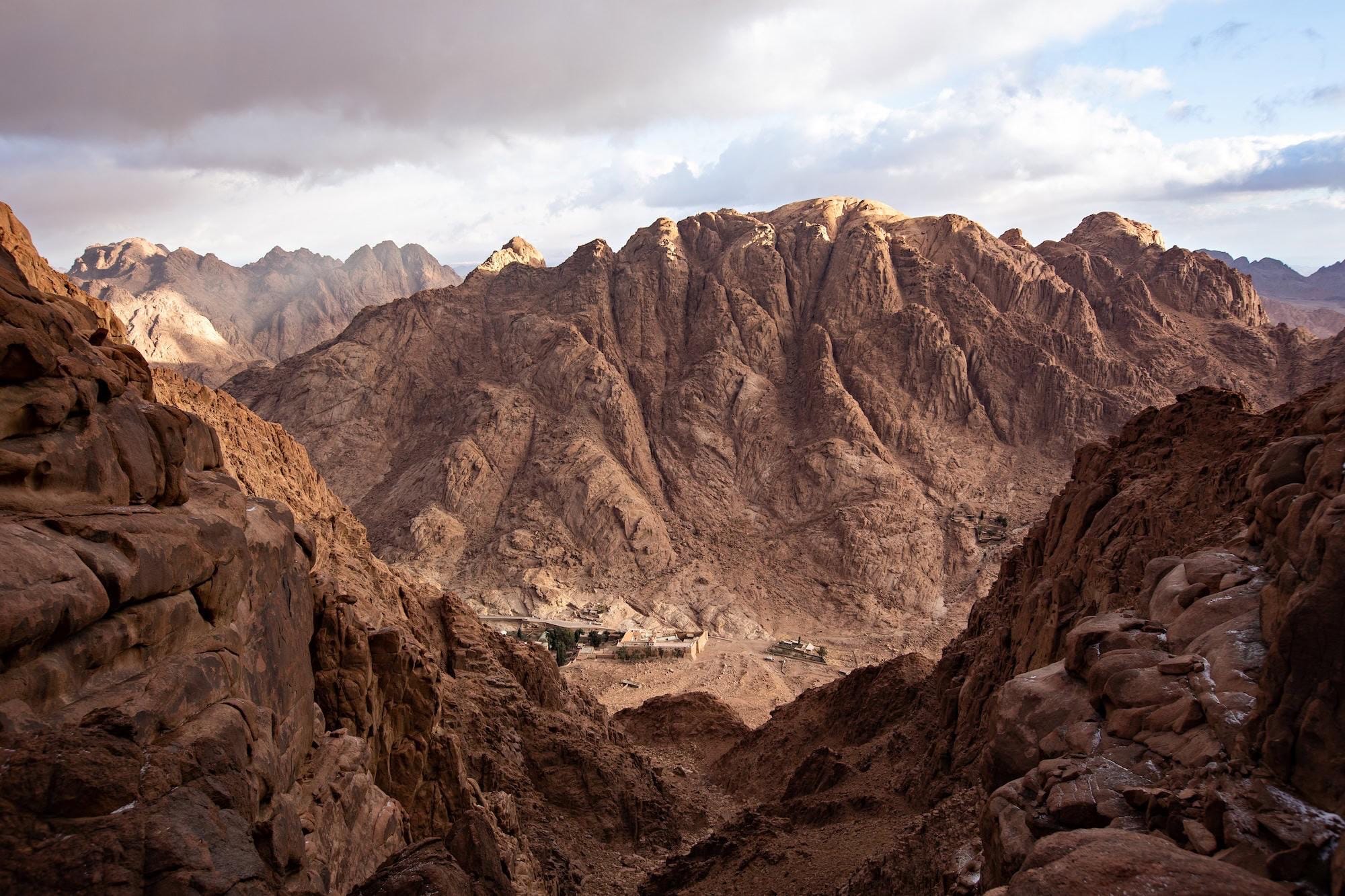
In the heart of South Sinai lies a place unlike any other. Saint Catherine. A city surrounded by mountains, silence and centuries of memory. A place where nature, history and faith have met for generations. A place many have come to call… the Land of Religions. Saint Catherine rises on a high plateau, approximately sixteen hundred meters above sea level, making it one of the highest inhabited places in Sinai.
02EXT. SAINT CATHERINE — DAY
SCENE 2 — A CITY WITHIN THE MOUNTAINS
Harsh in appearance, the mountains protect a surprisingly rich environment. Springs and sources of fresh water have helped sustain life in these valleys for generations. Its natural beauty is matched by its historical, cultural and religious importance. Yet Saint Catherine is more than a city surrounded by stone. Every valley carries a story.
03EXT. BEDOUIN SETTLEMENT / NABATIYEH VILLAGE — DAY
SCENE 3 — THE PEOPLE OF THE VALLEYS
Beyond the main city, Bedouin communities have built their lives among the mountains. In villages such as Nabatiyeh, generations have adapted to the severe geography of Sinai without surrendering their connection to the land. Grapes, apples, figs, berries and plums are cultivated wherever the soil and water allow. Goats and sheep remain part of the traditional economy, helping families move toward a remarkable degree of self-sufficiency.
04EXT. WADI AL-ARBAEEN — DAY
SCENE 4 — WADI AL-ARBAEEN
Among these valleys is Wadi Al-Arbaeen — the Valley of the Forty — within the Saint Catherine Protectorate. The film's record describes a small Bedouin community of roughly twenty-five homes and more than one hundred and fifty residents, whose connection to this valley reaches back decades. Here, scale changes everything. Houses become small beneath the mountains.
05EXT. ANCIENT STONE STRUCTURES — DAY
SCENE 5 — TRACES OF THOSE WHO CAME BEFORE
Saint Catherine also preserves traces of communities far older than the modern city. Below the mountains stand groups of ancient stone structures. Some are circular in form. Human remains discovered within structures of this kind have led to their interpretation as ancient burial places. In Sinai, even silence can become an archaeological record.
06EXT. MOUNTAIN SHRINES — DAY
SCENE 6 — THE MOUNTAINS OF THE PROPHETS
Religious memory extends far beyond the walls of the monastery. Local tradition associates shrines in these mountains with figures revered across the Abrahamic faiths. One is associated with the Prophet Saleh. Another is linked with Aaron, brother of Moses, on a hill facing the area traditionally associated with the Golden Calf. Whether approached through scripture, tradition or local memory, these places demonstrate how deeply sacred history has become woven into the…
07EXT. MOUNT MOSES — PRE-DAWN
SCENE 7 — MOUNT MOSES
Among all these mountains, one name has drawn pilgrims for centuries. Mount Moses. Visitors climb through the darkness to reach its summit before sunrise. From here, mountain ranges seem to continue without end. At dawn and sunset, stone, shadow and light transform the landscape into a spectacle that words struggle to contain. And at the summit, a small church stands near a mosque.
08INT. MONASTERY / ICON COLLECTION — LOW LIGHT
SCENE 8 — THE STORY OF SAINT CATHERINE
The name of the city is inseparable from the woman whose story became part of its identity. The tradition preserved in the film traces Catherine's story to Alexandria. She is remembered for learning, wisdom and modesty — and for a faith she refused to abandon. According to the tradition recounted here, during an age of persecution she rejected the worship of idols and remained steadfast in her Christian faith.
09INT. ICON / PAINTING — CONTINUOUS
SCENE 9 — THE LEGEND OF THE MOUNTAIN
Christian tradition tells that angels carried her body away from Alexandria… …across the wilderness… …and placed it upon a mountain in Sinai. Centuries later, according to the story, monks received a vision. They climbed the mountain and found the remains. The relics were brought down and eventually transferred to the monastery, where the memory of Catherine became permanently attached to the place.
10EXT. SAINT CATHERINE'S MONASTERY — DAY
SCENE 10 — THE MONASTERY
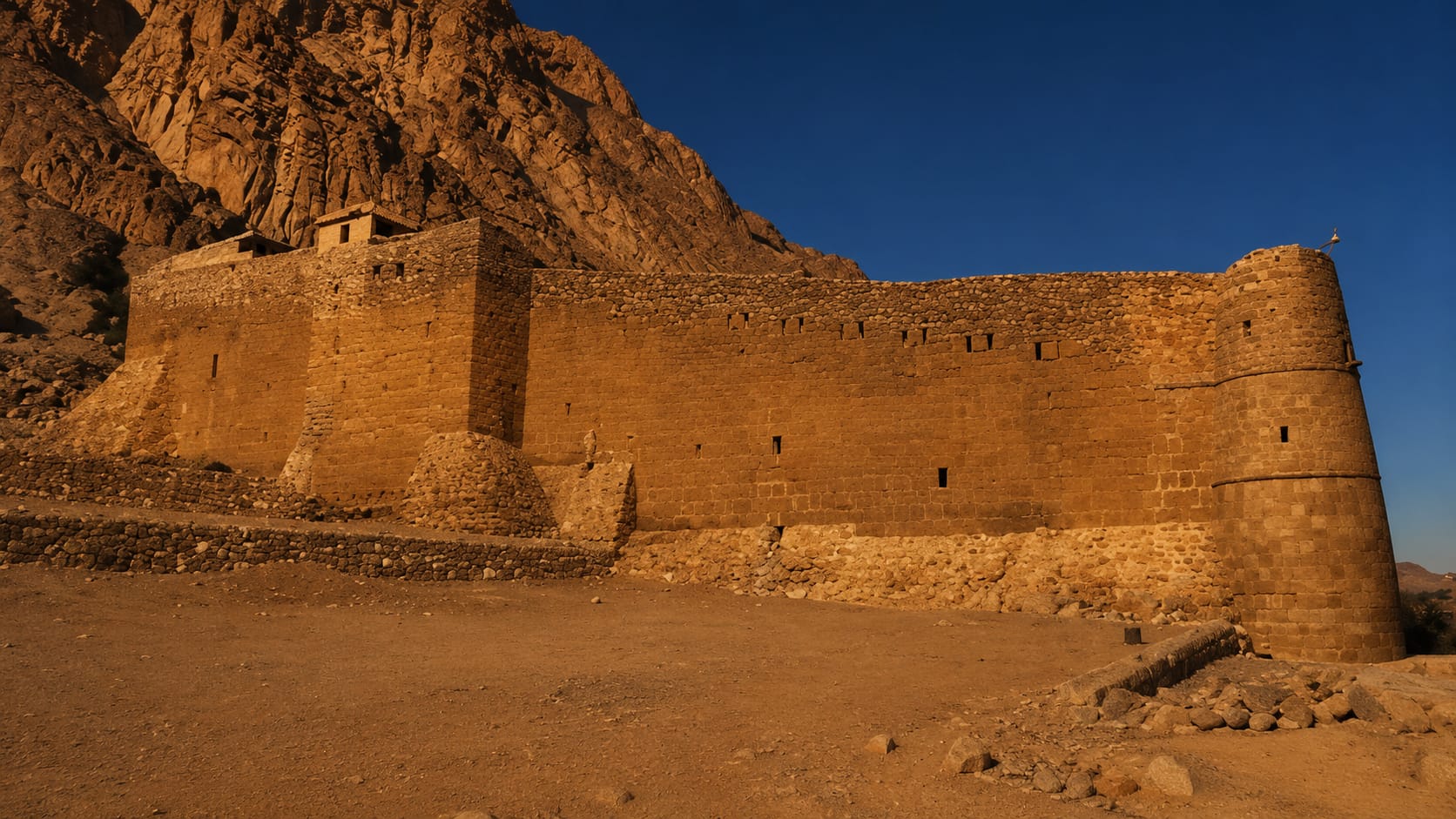
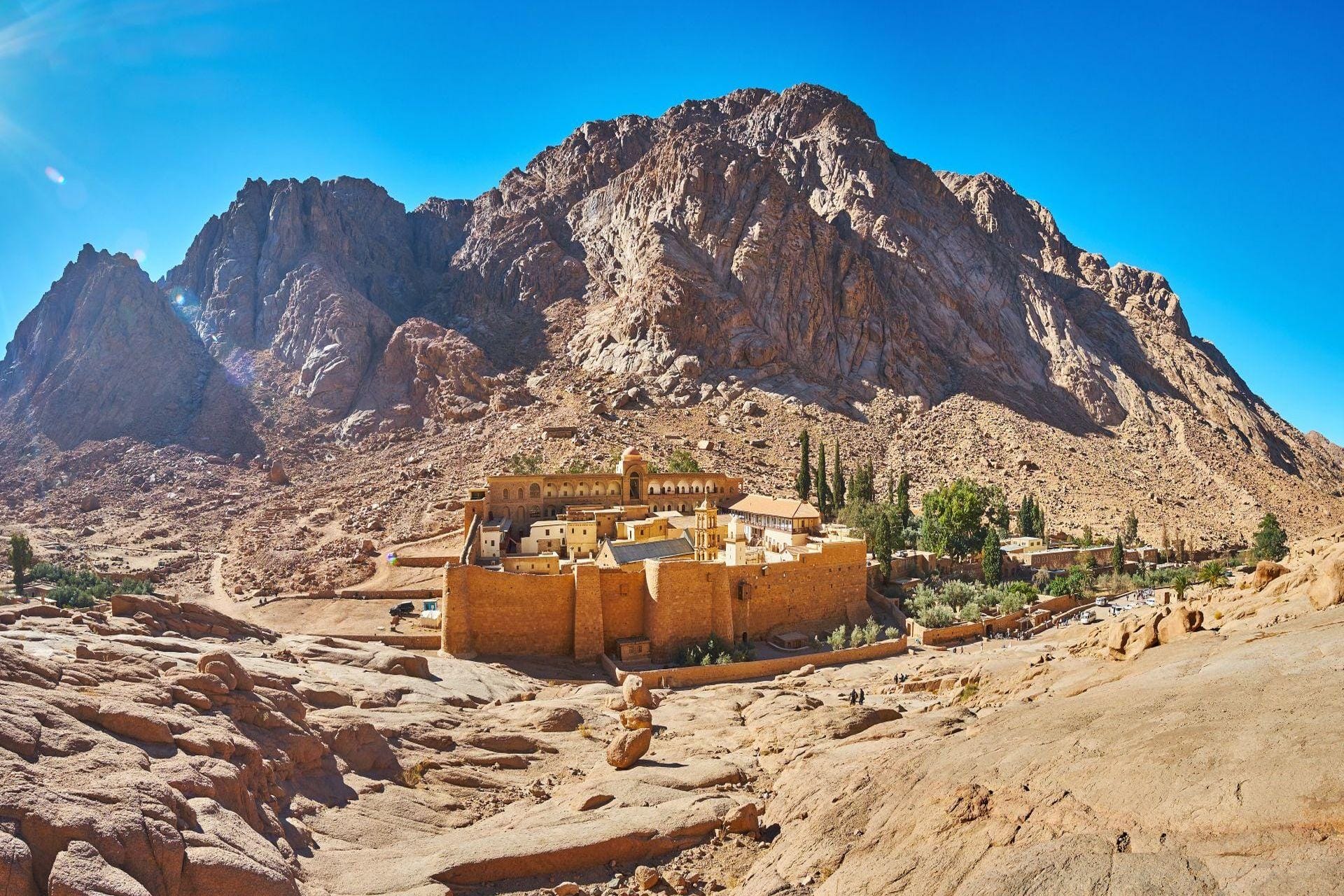
At the foot of the mountains stands the monument at the heart of Saint Catherine's spiritual identity. Saint Catherine's Monastery. The monastery was built during the reign of Emperor Justinian in the sixth century AD. Behind its walls are centuries of worship, art, manuscripts and memory. Generations entered these doors carrying different languages and histories.
11INT./EXT. MONASTERY COURTYARD — DAY
SCENE 11 — THE SACRED BUSH
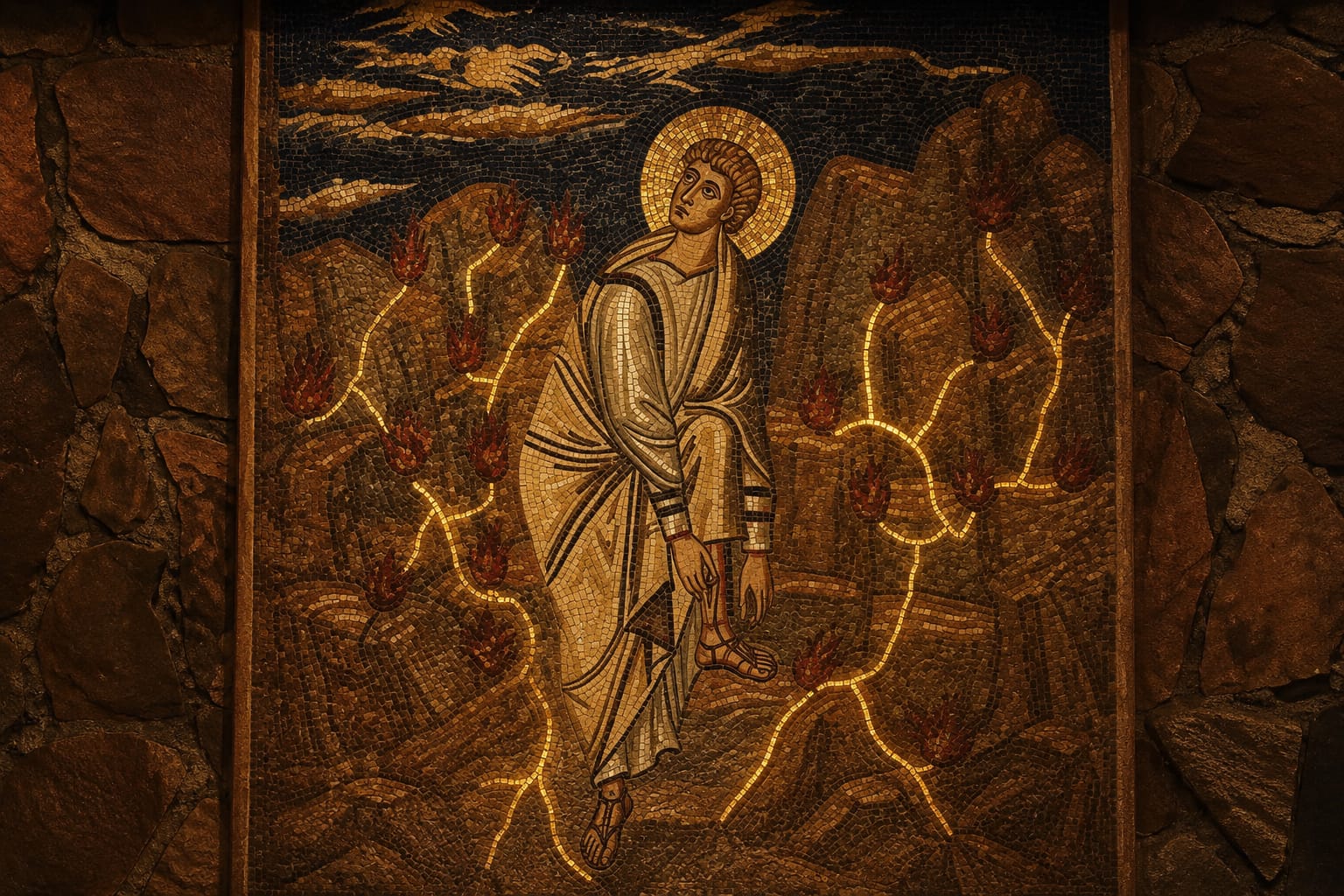
Within the monastery stands another object of profound religious significance. The sacred bush traditionally associated with the Biblical story of Moses and the Burning Bush. Here, scripture is not remembered only through books. It is connected to the landscape itself.
12INT. MONASTERY — MOSQUE AREA
SCENE 12 — A MOSQUE WITHIN A MONASTERY
One of the most remarkable features of the monastery is not a church. It is a mosque. The source material refers to it by names including the Omari Mosque and the Mosque of Al-Hakim bi-Amr Allah. Its exact historical attribution has been told in different ways, but its presence carries a powerful meaning. A Muslim place of prayer standing within one of Christianity's oldest monastic communities.
13INT. MONASTERY LIBRARY / MUSEUM — DAY
SCENE 13 — THE LIBRARY
Behind these walls lies another treasure. The monastery's library consists of rooms filled with thousands of ancient manuscripts. Arabic texts sit within a collection formed across centuries, languages and traditions. Rare manuscripts preserve theology, history, correspondence and the intellectual life of generations long gone. Among the documents presented in the film is a text traditionally attributed to the Prophet Muhammad — peace be upon him — and associated with…
14INT. MONASTERY MUSEUM / CHURCH — DAY
SCENE 14 — ICONS, ART AND MEMORY
The monastery's heritage is not written only in ink. Russian and Greek icons, oil paintings, murals and inscriptions preserve another visual archive. Some objects were made for worship. Others were gifts — objects of extraordinary value exchanged among rulers, princes, pilgrims and religious communities. Together, they turn the monastery into more than a building.
15INT. OSSUARY — LOW LIGHT
SCENE 15 — THE DEAD OF THE MONASTERY
Life inside a monastery is also a meditation on death. An ossuary preserves the remains of monks and religious figures who lived and died here. The film also refers to private monastic burial places reserved for monks and bishops. Their names may disappear. Their remains may become indistinguishable. But together, they form another chapter in the monastery's uninterrupted human story.
16EXT. SAINT CATHERINE / MOUNTAINS — GOLDEN HOUR
SCENE 16 — THREE FAITHS, ONE LANDSCAPE
Judaism, Christianity and Islam approach Sinai through different traditions. Yet here, their stories repeatedly meet the same mountains. Moses. Aaron. Christian monks. Muslim rulers. Bedouin communities. Pilgrims from across the world. Their histories do not erase one another. They accumulate.
17EXT. RELIGIONS COMPLEX SQUARE — DAY
SCENE 17 — THE MURAL OF SAINT CATHERINE
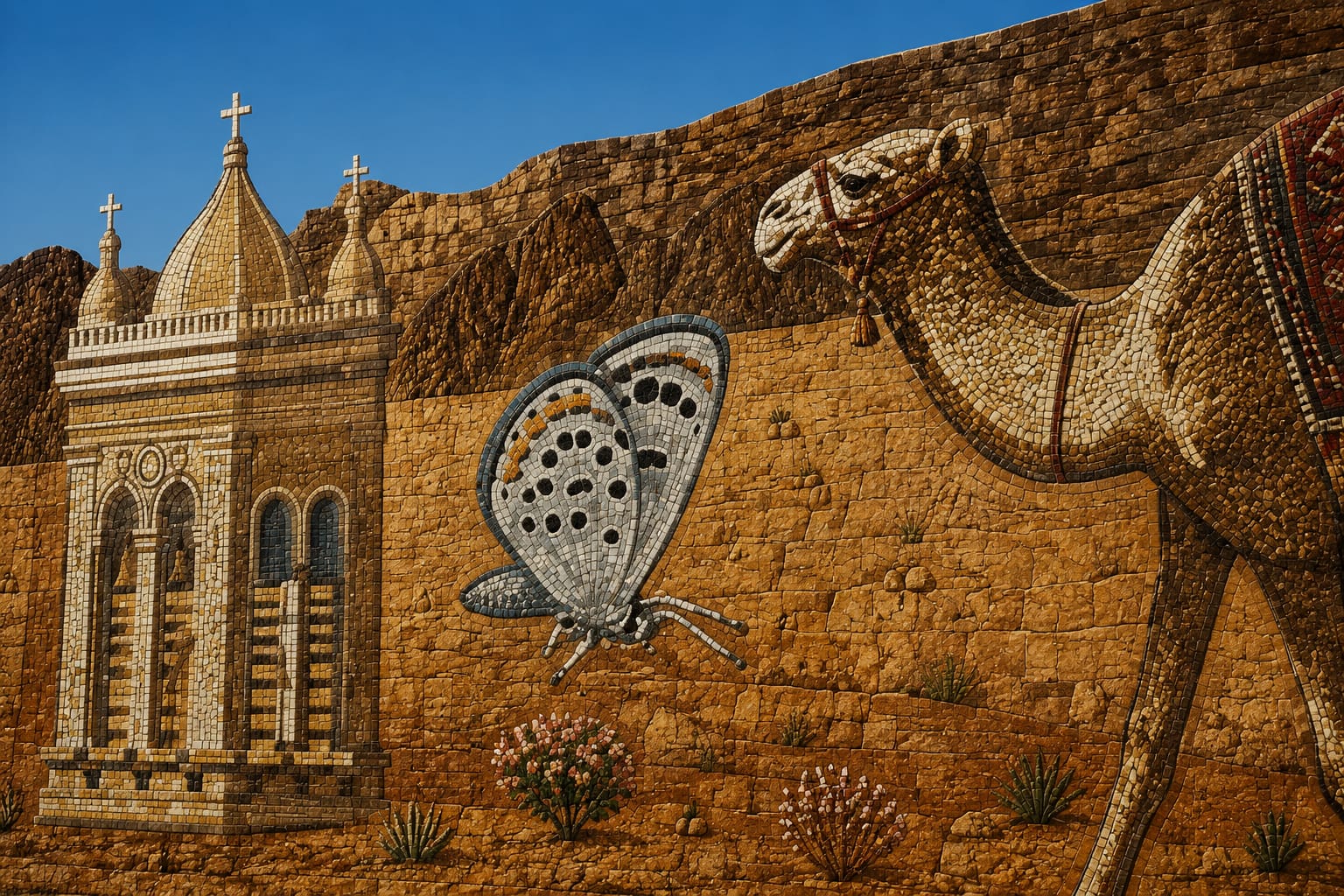
In modern Saint Catherine, that accumulated history has been translated into a new visual language. In May 2016, a monumental mural was inaugurated in the city. Created in the square of the Religions Complex, the artwork gathers symbols of Saint Catherine into a single panorama. The church. The mosque. Bedouin heritage. The wildlife of the protectorate.
18EXT. SAINT CATHERINE — SUNSET
SCENE 18 — WHAT THE MOUNTAINS REMEMBER
Saint Catherine cannot be understood through one monument alone. It is the village. The monastery. The mountain. The shrines. The manuscripts. The people who learned how to live in one of Egypt's most demanding landscapes. Each carries only part of the story.